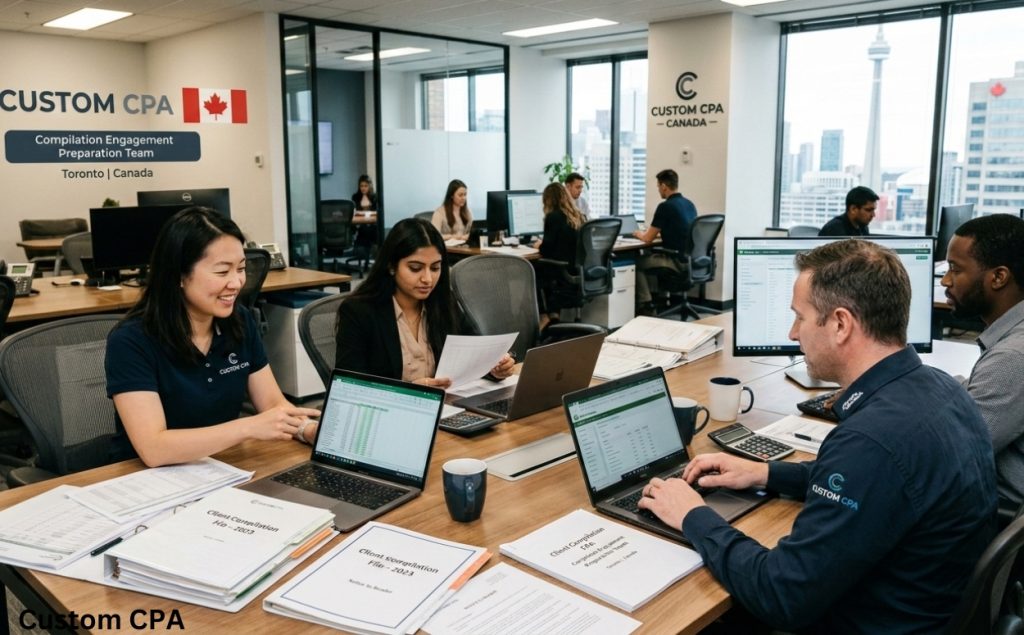
Starting your first compilation engagement with a CPA doesn't have to be overwhelming — but it does require preparation. This complete onboarding checklist walks you through every document, decision, and step involved in your first compilation under the CSRS 4200 standard in Canada. From gathering your financial records and signing your engagement letter, to understanding what your CPA will produce and what you need to do with it, this guide ensures your first compilation is efficient, accurate, and sets the foundation for annual financial reporting that actually serves your business.
1. What Is a Compilation Engagement?
A compilation engagement is the process by which a CPA assembles your financial information into a set of formal financial statements — an income statement (profit & loss) and a balance sheet, at minimum — without performing audit or review procedures. Under CSRS 4200 (the Canadian Standard on Related Services for compilation engagements), the CPA does not express any assurance that the financial statements are accurate. Management — that's you — is responsible for the underlying information. The CPA's role is to apply accounting expertise to present that information in the correct format.
This is the most common level of financial reporting for Canadian private companies. Banks, government programs, investors, and business purchasers routinely accept compilation financial statements for business decisions — particularly for smaller and medium-sized businesses. Understanding what you're getting and what you're agreeing to when you sign the engagement letter is the first step in a successful client-CPA relationship.
Before diving into the onboarding checklist, it's worth understanding how the monthly bookkeeping you do throughout the year feeds directly into the compilation. Our guide on Understanding Your Monthly Bookkeeping Report explains the financial statements your CPA will formalize, and our DIY Bookkeeping vs. Professional Experts guide explains how your bookkeeping quality affects the compilation cost and timeline.
📋
CSRS
4200 — the Canadian professional standard governing all compilation engagements since Dec 2021
⏱️
3–6
Weeks for a first-time compilation from documents received to statements delivered
📄
2
Core financial statements produced: Income Statement and Balance Sheet (minimum)
✍️
1
Engagement letter must be signed by management before CPA begins any work — CSRS 4200 requirement
📋 Ready to Start Your First Compilation Engagement?
Custom CPA guides first-time compilation clients through every step — from document gathering to final statements — with clear communication throughout.
Compilations are required or strongly recommended in several common Canadian business situations. Understanding which applies to you helps you plan the engagement timeline correctly.
Situation
Why Compilation Is Needed
Typical Urgency
Bank Loan Application
Lenders require formal financial statements to assess creditworthiness and DSCR
🔴 High — tied to loan application deadline
CSBFP / BDC Financing
Government-backed lending programs require compiled statements for businesses with operating history
🔴 High — tied to program application
Corporate Tax Return (T2)
While not legally required, compiled statements provide the foundation for accurate T2 preparation and CRA compliance
🟡 Medium — T2 due 6 months after fiscal year-end
Business Sale / Purchase
Buyers require formal financial history; solicitors and accountants use compiled statements in due diligence
🔴 High — deal timeline driven
Investor / Shareholder Reporting
Shareholders and investors require formal financial statements showing business performance
🟡 Medium — annual cycle
Government Grant Programs
Many federal/provincial programs (IRAP, CMC, ISED) require financial statements for eligibility verification
🟡 Medium — program deadline driven
Annual Financial Record-Keeping
Best practice for all incorporated businesses — provides a formal, defensible financial record for CRA purposes
🟢 Routine — annually after fiscal year-end
After your first compilation is complete, our Post-Compilation Follow-Up Checklist guides you through the distribution, tax filing, and bookkeeping reset steps that follow each annual compilation.
3. Phase 1 — Engagement Setup (Days 1–5)
Before your CPA can begin any compilation work, several administrative steps must be completed. Under CSRS 4200, the engagement letter must be signed before the work starts — no exceptions. These setup tasks should be completed in the first week of the engagement.
1
Engagement Setup Checklist
Complete before any compilation work begins
Review and sign the Engagement Letter — this document defines the scope of the engagement, the basis of accounting to be used (e.g., ASPE — Accounting Standards for Private Enterprises), the fee estimate, and both parties' responsibilities. Read it carefully before signing. Required Before Start
Confirm fiscal year-end date — most Canadian corporations have a non-December year-end; confirm your company's fiscal year-end to ensure the correct reporting period is used. Required
Confirm basis of accounting — most private Canadian businesses use ASPE (Accounting Standards for Private Enterprises); some use a special purpose framework. Confirm which applies to your situation. Your CPA will guide you.
Confirm intended distribution — under CSRS 4200, the engagement letter must specify who will receive the compiled statements (bank, shareholders, etc.). Identify all intended recipients now. Adding new recipients later requires engagement letter revision. CSRS 4200
Provide your business registration information — legal business name, Business Number (BN), province of incorporation, registered address, and director/shareholder details for the compilation file.
Discuss CPA onboarding fee — first-time compilations typically cost more than subsequent annual engagements because the CPA must establish the opening chart of accounts, identify prior-year issues, and set up the engagement file from scratch. Confirm the fee estimate upfront. First-Year Note
4. Phase 2 — Document Gathering Checklist
The single biggest factor affecting the speed and cost of your compilation is the completeness and organization of the documents you provide. The more organized your records, the less time your CPA spends tracking down information — and the lower your bill. Here is the complete document checklist for a first-time compilation:
2
Complete Document Gathering Checklist
Gather all items before submitting to your CPA
Year-end bank statements — all accounts — the statement for the last month of your fiscal year for every business bank account and savings account. Confirm no accounts are missing. Required
Year-end credit card statements — the statement for every business credit card at fiscal year-end. Includes any personal cards used for business expenses. Required
Trial balance or accounting software export — if you use QuickBooks, Xero, or Sage, export the full trial balance report as at your fiscal year-end. This is the foundation the CPA builds the financial statements from. Required
Accounts receivable list at year-end — a list of all customers who owed money at fiscal year-end, with the amount and how long it has been outstanding.
Accounts payable list at year-end — a list of all supplier invoices unpaid at fiscal year-end and their amounts.
Loan and credit facility statements at year-end — year-end statement for every bank loan, line of credit, equipment lease, and shareholder loan showing the outstanding balance. Required
GST/HST account statement — download your GST/HST account summary from CRA My Business Account showing all returns filed for the fiscal year and any balance owing. Required
Payroll records — T4 Summary, payroll register showing total wages, CPP/EI remittances, and any accrued vacation pay at year-end. For payroll compliance details see our Payroll Tax Compliance Checklist. If Applicable
Asset list and purchase dates — all capital equipment, vehicles, and significant purchases made during the year with purchase prices and dates (for CCA/depreciation calculation).
Prior year financial statements — if you have any prior year financial statements (even informal ones), provide them. Your CPA will use prior-year comparatives to identify unusual trends. If Available
Inventory count / valuation at year-end — if your business holds inventory, provide a physical count and valuation (at cost) as at fiscal year-end. For retail businesses, see our bookkeeping quality guide for inventory best practices. If Applicable
Leading Causes of First-Time Compilation Delays — % of Engagements Affected
Missing bank statements
64%
64%
Unreconciled accounting books
71%
71%
Missing loan/credit statements
48%
48%
No payroll records available
42%
42%
Personal/business expenses mixed
58%
58%
📁 Not Sure If Your Documents Are Ready?
Custom CPA offers a pre-compilation document review — we'll tell you exactly what's needed and what can be cleaned up before the engagement starts.
The quality of your bookkeeping records directly determines the cost, speed, and accuracy of your compilation. Before your CPA can prepare financial statements, the underlying transactions must be correctly recorded and reconciled. Here's what "compilation-ready" bookkeeping looks like:
3
Bookkeeping Readiness Checklist
Reduces CPA time and your compilation cost
All bank accounts reconciled to year-end statements — the closing balance in your accounting software must match the year-end bank statement for every account. This is the single most important bookkeeping task before compilation. Critical
All transactions categorized — no "uncategorized" or "ask my accountant" categories in your chart of accounts. Every transaction should be assigned to a specific account.
Business and personal expenses separated — if personal expenses have been run through the business account, they must be identified and reclassified. Mixed expenses are the most common bookkeeping problem CPA firms encounter. Frequent Issue
GST/HST correctly tracked — all sales with GST/HST collected and all eligible GST/HST paid on business expenses recorded properly. The GST balance in your books must reconcile to your CRA account.
No duplicate or missing transactions — especially if bank feeds were used, review for duplicate imports or transactions that were missed. These distort both the P&L and balance sheet. Common Error
⚠️
Bookkeeping Cleanup Cost: If your books are significantly disorganized at the time of engagement, your CPA will charge additional fees for the bookkeeping cleanup required before the compilation can proceed. This cleanup cost is almost always higher than what proper ongoing bookkeeping would have cost throughout the year. Investing in quality monthly bookkeeping is always more cost-effective than paying for year-end cleanup. See our DIY vs. Professional Bookkeeping Cost Analysis.
6. Phase 4 — What Your CPA Does During Compilation
Understanding what your CPA actually does during the compilation process helps you set realistic expectations, respond to queries quickly, and appreciate why the engagement takes the time it does. Here's the CPA's process:
Step
What the CPA Does
Your Involvement
1. Receive & Review Documents
Reviews all submitted documents; identifies gaps; confirms trial balance ties to bank reconciliations
Respond promptly to any requests for missing items
2. Adjust Opening Balances
For first-time clients: establishes opening balances from prior records or inception documents
Provide any prior-year information or incorporation documents
3. Post Adjusting Journal Entries
Records depreciation (CCA), accruals, reclassifications, and any needed corrections to the trial balance
Approve significant adjustments that affect your reported results
4. Prepare Draft Financial Statements
Formats the income statement and balance sheet per the agreed basis of accounting (ASPE or other)
Review draft statements; confirm numbers match your understanding
5. Prepare Compilation Report
Drafts the CSRS 4200 compilation report with required language: no assurance expressed, management responsibility paragraph
Read the report — you are affirming management responsibility
6. Management Approval
Sends final package for your review and written approval
Review, ask questions, and provide written approval — required under CSRS 4200
7. Issue Final Statements
Signs and dates the compilation report; delivers final package
Distribute to identified parties; retain copies per CRA requirements
7. Phase 5 — Review, Approval & Distribution
Your involvement doesn't end when the CPA sends the draft. Under CSRS 4200, you are required to review and formally approve the financial statements before they are finalized. Here is what to check before you sign off:
5
Client Review & Approval Checklist
Complete before providing written management approval
Revenue figure matches your records — total annual revenue on the income statement should align with your invoicing records. Flag any discrepancy immediately. Verify
All major expenses appear and are correctly categorized — scan the expense lines to ensure nothing significant is missing and no personal items appear as business expenses.
Balance sheet cash matches year-end bank statement — the cash balance on the balance sheet should match your bank statements at fiscal year-end. Verify
Loan balances match lender statements — confirm each loan balance on the balance sheet matches the year-end statement from your bank or lender.
Understand all adjusting journal entries — ask your CPA to explain any adjustments made that significantly changed your numbers. You should understand every entry before approving. Important
Read the compilation report — understand that by approving, you are accepting management responsibility for the information. The CPA expressly states no assurance is given.
Provide written approval — typically an email or signed management representation letter. Archive this along with the final statements. CSRS 4200 Required
Initial consultation, engagement letter drafted and signed, fiscal year confirmed, basis of accounting agreed, intended distribution identified.
W2
Weeks 1–2 — Document Gathering (Client)
You gather and submit all required documents: bank statements, trial balance, loan statements, payroll records, GST/HST account, AR/AP listings, asset list.
W3
Week 3 — CPA Review & Queries
CPA reviews documents, identifies gaps, sends queries for missing information or clarification. Respond to all queries within 48–72 hours to maintain momentum.
W4
Weeks 3–5 — Preparation
CPA posts adjusting journal entries, prepares draft financial statements, drafts compilation report. (First-time engagements take longer due to opening balance establishment.)
W5
Week 5–6 — Draft Review & Approval
Draft statements sent to you for review. You ask questions, request explanations for adjustments, confirm all figures, and provide written management approval.
W6
Week 6 — Final Issue & Distribution
CPA signs and dates the compilation report, delivers the final package. You distribute to identified parties and retain copies per CRA 6-year retention requirement.
9. Cost Factors & How to Reduce Them
First-time compilation costs are higher than subsequent annual compilations — but there are concrete steps you can take to keep costs manageable. For SaaS companies and businesses with additional tax complexity, see our SaaS Tax Planning Guide for the specific documentation those businesses should prepare.
Cost Factor
Typical Impact on Fee
How to Reduce
Disorganized books
+$500 – $2,500 (cleanup fees)
Maintain monthly reconciled books throughout the year; provide organized trial balance
No prior-year statements
+$300 – $800 (first-year opening balance work)
Unavoidable for first compilation — reduces every year thereafter
Missing documents
+$100 – $400 per round of follow-up
Use this checklist to gather everything before submission
Mixed personal/business expenses
+$200 – $600 (reclassification time)
Maintain a dedicated business bank account and credit card from day one
Complex ownership structure
+$400 – $1,500 (related party transactions, multiple entities)
Discuss structure with CPA before engagement begins
Slow client response to queries
Delays completion; may add $200–$500 in re-engagement costs
Respond to all CPA queries within 48–72 hours
✅
Annual Savings Tip: The best investment you can make in reducing long-term compilation costs is investing in quality monthly bookkeeping. Clean, reconciled books produced every month mean your CPA spends minimal time on cleanup and maximum time on the actual financial statements — and your annual compilation fee stays competitive year after year. Our Core Accounting & Tax Services and Specialized Services include full-cycle bookkeeping and compilation in an integrated service package.
✅ Start Your First Compilation the Right Way
Custom CPA guides first-time clients through a streamlined, clearly communicated compilation process — from initial document gathering to final statement delivery.
What documents does a CPA need for a compilation engagement?
▼
For a compilation engagement, your CPA typically requires: year-end bank statements for all business accounts, a full trial balance or accounting software export, all sales invoices and revenue records, all purchase receipts and expense documentation, loan and credit facility year-end statements, payroll records (T4 summary, payroll register), GST/HST returns and CRA account statement, accounts receivable and payable listings at year-end, a capital asset list with purchase dates and costs, and the prior year financial statements if available. The more organized these records are when submitted, the faster and less expensive the compilation process will be.
How long does a first-time compilation engagement take in Canada?
▼
A first-time compilation engagement typically takes 3–6 weeks from the date all required documents are received by the CPA. First-time engagements are longer because there are no prior-year comparatives, the CPA must establish the chart of accounts and opening balances, and any bookkeeping cleanup must be completed before financial statements can be prepared. Subsequent annual compilations are typically faster (2–4 weeks) because the prior-year structure is already established. Client responsiveness to CPA queries is the single biggest factor affecting actual timelines — responding within 48 hours to any questions keeps the process moving.
What is the difference between a compilation and an audit in Canada?
▼
There are three levels of financial statement engagement in Canada, from lowest to highest assurance: Compilation (CSRS 4200) — the CPA assembles financial statements from management-provided information; no verification procedures are performed and no assurance is expressed. Management is responsible for the accuracy of the information. Review (CSRS 2400) — the CPA performs analytical procedures and inquiry to obtain limited assurance that the statements are plausible; a negative assurance statement is expressed. Audit (GAAS) — the CPA independently verifies the financial information through testing and expresses an opinion on whether statements are fairly presented. Compilation is the fastest and least expensive; audit is the most comprehensive and most expensive. Most private Canadian businesses require compilation for lending, government programs, and management purposes.
Do I need to fix my bookkeeping before starting a compilation?
▼
Not necessarily — but the more accurate and organized your bookkeeping records, the lower the compilation cost and the faster it proceeds. If your books are significantly disorganized (unreconciled accounts, mixed personal and business expenses, uncategorized transactions), your CPA will need to perform bookkeeping cleanup before the compilation can proceed — and this adds cost. The most cost-effective approach is maintaining well-reconciled monthly bookkeeping throughout the year. If you're starting a first-time compilation with disorganized records, discuss the situation with your CPA before the engagement begins so the cleanup cost can be estimated and budgeted. Providing a clean trial balance and reconciled bank accounts is the single biggest thing a client can do to reduce compilation cost and time.
What is the CSRS 4200 standard and how does it affect my compilation?
▼
CSRS 4200 (Canadian Standard on Related Services 4200) is the professional standard governing all compilation engagements in Canada. It took effect December 14, 2021 and replaced the older Section 9200 standard. Key requirements under CSRS 4200 that affect you as a client: (1) Your CPA must obtain a signed engagement letter before beginning any compilation work; (2) The compilation report must include a statement that no assurance is expressed and a paragraph describing management's responsibility for the financial information; (3) The report must specify the basis of accounting used; (4) You must provide written management approval before the final statements are distributed; (5) The statements must always be distributed with the full compilation report attached — never the financial statements alone. Understanding these requirements ensures you're prepared for what your CPA will ask of you during the engagement.
📋 Ready to Start? Custom CPA Makes First-Time Compilations Simple.
We walk first-time clients through every step — clear expectations, organized document requests, and financial statements delivered on time.
Disclaimer: The above contents are provided for general guidance only, based on information believed to be accurate and complete, but we cannot guarantee its accuracy or completeness. It does not provide legal advice, nor can it or should it be relied upon. Please contact/consult a qualified tax professional specific to your case.
Compilation Engagement Preparation Checklist 2026 | Custom CPA Compilation Engagement Preparation Checklist 2026 Get Your Business Ready for a Successful […]