Custom Accounting & CFO Advisory | Saskatchewan

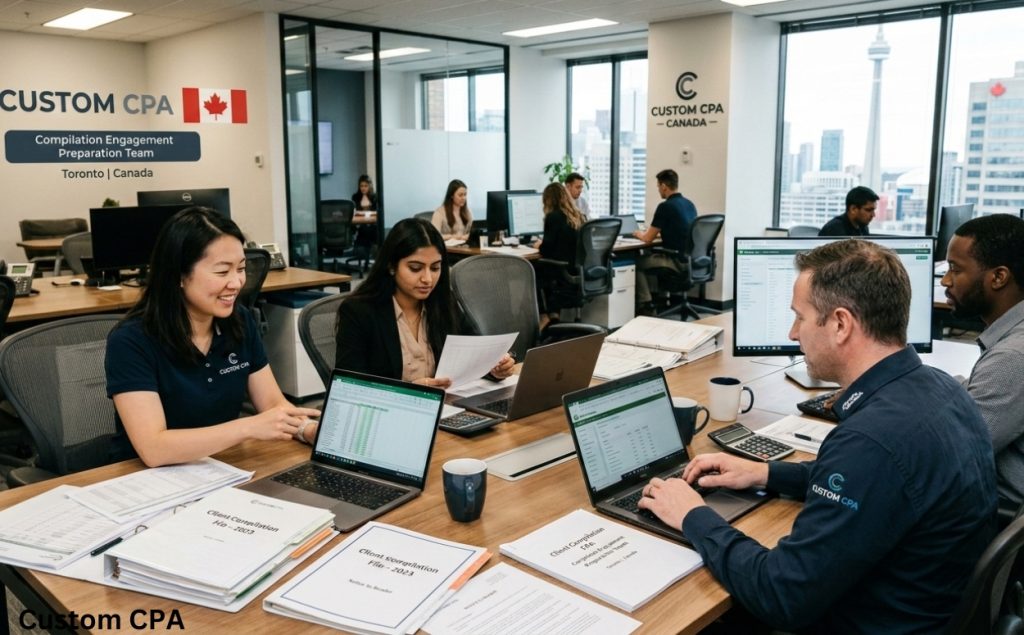
Financial Statement Compilation Services for Small Businesses Canada | Custom CPA
Canadian CPA Services

Financial Statement Compilation Services
for Small Businesses in Canada

πŸ“Œ Quick Summary

Every incorporated small business in Canada needs formally prepared financial statements β€” yet most business owners don't fully understand what a compilation engagement includes, when it's required, what it costs, or how to get one done efficiently. This complete guide explains CPA-prepared financial statement compilation services for Canadian small businesses: what's included, the difference between compilation, review, and audit, ASPE requirements, what your CPA needs from you, how to reduce the cost with better bookkeeping, and the timelines you should expect.

1. What Is a Financial Statement Compilation?

A financial statement compilation is a formal CPA engagement β€” governed by Canadian Standard on Related Services 4200 (CSRS 4200) β€” where a CPA assembles management-provided financial information into a complete set of financial statements. The CPA does not audit or verify the numbers; instead, they apply professional accounting judgment to present the information correctly, on the appropriate accounting basis (typically ASPE), with proper notes and disclosures.

Prior to December 2021, compiled financial statements included a document called the "Notice to Reader" β€” a short report explaining the nature of the engagement. Under CSRS 4200 (which replaced the old Section 9200), compiled statements now include a Compilation Engagement Report that describes the basis of accounting used, explains that the CPA has not performed audit or review procedures, and confirms that readers should refer to the described basis to understand the statements.

Compiled financial statements are the most common type of annual financial statements for Canadian small businesses β€” and for good reason. They provide a professional, formally presented set of financials suitable for lenders, the CRA, investors, and management decision-making, at a significantly lower cost than a review or audit. For businesses that need to understand what their monthly financial reports should look like between annual compilations, our Monthly Bookkeeping Report Guide covers the financial reporting that feeds directly into the compilation.

πŸ“‹
CSRS
4200 β€” the professional standard governing compilation engagements in Canada (effective Dec 2021)
🏦
95%
Of Canadian bank loans to small businesses require annual compiled financial statements
πŸ’°
$800+
Starting cost for a simple compilation β€” 100% tax-deductible as a business expense
πŸ“…
6 yrs
Minimum record retention required by CRA β€” compiled statements are your annual record

πŸ“‹ Need Your Annual Financial Statements Prepared?

Custom CPA prepares ASPE-compliant compiled financial statements for Canadian small businesses β€” delivered efficiently, accurately, and on time for your lenders and CRA.

2. Who Needs a Financial Statement Compilation in Canada?

Not every business needs an annual compilation β€” but most incorporated Canadian businesses do, and many unincorporated businesses benefit from one. Here is a practical guide to when a compilation is required or strongly recommended:

Business Situation Compilation Needed? Reason
Incorporated business (CCPC) with bank loan or line of credit βœ… Yes β€” typically required annually Most Canadian banks require annual compiled financial statements as a loan covenant
Incorporated business applying for new financing βœ… Yes β€” required before application Lenders will not assess a financing application without current financial statements
Incorporated business β€” no bank debt βœ… Strongly recommended Required for T2 preparation; useful for management; needed if bank debt is ever sought
Sole proprietor filing T1 Business Income ⚠️ Usually not required β€” T2125 suffices T1 filers use the T2125 schedule; a formal compilation is optional but beneficial above $500K revenue
Business with investors or partners βœ… Yes β€” typically required Partners and investors have a right to formal financial reporting under most partnership/shareholder agreements
Business being sold or valued βœ… Yes β€” required by buyers and valuators Business sale due diligence always requires at least 3 years of compiled financial statements
Government grant or program applications βœ… Often required Many federal and provincial programs (BDC, EDC, provincial grants) require compiled financials
CRA audit or review βœ… Yes β€” often requested CRA may request formal financial statements as part of a T2 review or audit of a corporation

3. Compilation vs. Review vs. Audit β€” Choosing the Right Level

Canadian CPA engagements for financial statement preparation come in three levels of assurance. Understanding the difference helps you meet your stakeholders' requirements without paying for more than you need.

Level 1 β€” Most Common
Compilation
  • CPA assembles management's financial information
  • No audit or review procedures performed
  • No assurance expressed by CPA
  • Compilation Engagement Report included
  • ASPE basis β€” full notes required
  • Accepted by most Canadian banks and lenders
  • Required for T2 preparation
πŸ’° $800 – $3,500+ / year
Level 2 β€” Some Lenders
Review Engagement
  • CPA performs analytical procedures and inquiry
  • Limited (negative) assurance expressed
  • Review Report included with statements
  • ASPE β€” full notes required
  • Required by some banks for larger loan facilities
  • Required for some investor reporting
  • Higher cost than compilation
πŸ’° $3,000 – $10,000+ / year
Level 3 β€” Required by Some
Audit
  • CPA independently verifies all significant balances
  • Positive assurance β€” opinion on financial statements
  • Auditor's Report with formal opinion
  • ASPE or IFRS
  • Required by some institutional lenders and PE investors
  • Required for public companies
  • Highest cost; most time-intensive
πŸ’° $8,000 – $40,000+ / year
ℹ️
What Does Your Lender Actually Require? Before engaging your CPA, read your loan agreement's financial reporting covenant carefully. Most Canadian bank loans to small businesses require "annual compiled financial statements prepared by a chartered professional accountant" β€” which means a CSRS 4200 compilation is sufficient. Some larger credit facilities (typically $5M+) may require reviewed statements. Confirm in writing with your lender what they need before the engagement begins β€” it affects both cost and timeline significantly.

4. What a Compilation Includes β€” Complete Deliverables

A complete compilation engagement under CSRS 4200 produces a formal financial statement package that typically includes the following components:

πŸ“„ Compilation Package β€” Complete Deliverables Checklist
Compilation Engagement Report β€” the CPA's report replacing the former "Notice to Reader." Describes the basis of accounting, confirms no audit or review was performed, and directs readers to the basis description. Required
Income Statement (Statement of Operations) β€” revenues, cost of goods sold, gross profit, operating expenses, and net income for the fiscal year, with prior year comparative figures. Required
Balance Sheet (Statement of Financial Position) β€” assets, liabilities, and shareholder equity at fiscal year-end, with prior year comparatives. Required
Statement of Retained Earnings (or Changes in Equity) β€” opening retained earnings, net income, dividends declared, and closing retained earnings. Required
Notes to Financial Statements β€” ASPE-required disclosures: basis of presentation, accounting policies, long-term debt details, related party transactions, lease commitments, contingencies, subsequent events, and more. Required
Capital Asset Schedule β€” detailed schedule of opening cost, additions, disposals, accumulated depreciation, and net book value by asset category. Typically presented as a supporting schedule or within the notes. Common Addition
Signed Management Representation Letter β€” management (the business owner) signs a letter confirming the completeness and accuracy of the information provided to the CPA. Required under CSRS 4200. Required by Standard

5. ASPE β€” The Accounting Standard for Canadian Private Companies

Almost all Canadian private small business compilations are prepared under ASPE β€” Accounting Standards for Private Enterprises (Part II of the CPA Canada Handbook). ASPE provides a simplified but complete accounting framework designed specifically for private companies β€” with certain disclosure exemptions not available under IFRS (the standard used by public companies and some larger private enterprises).

Key ASPE Disclosure Requirements β€” What Every Compiled Small Business Statement Must Include
Basis of presentation note
100% required β€” no exceptions
Required
Significant accounting policies
100% required in every compilation
Required
Long-term debt details
If any debt exists β€” required
If applicable
Related party transactions
Almost always present β€” owner salary, shareholder loans
If applicable
Commitments & contingencies
Leases, guarantees, pending litigation
If applicable
Subsequent events
Material events after fiscal year-end
If applicable
βœ…
ASPE Private Company Exemptions: Unlike IFRS, ASPE does not require: segment reporting; earnings per share disclosure; fair value measurement of most financial instruments (cost or amortized cost allowed); or disclosure of non-controlling interests in many situations. These exemptions significantly reduce the complexity and length of ASPE financial statements compared to IFRS β€” making ASPE the practical, cost-effective standard for Canadian small businesses. Your CPA will confirm whether ASPE or another basis is appropriate for your engagement. Our Core Accounting & Tax Services include annual compilation under ASPE as a standard offering.

πŸ“Š ASPE-Compliant Compilations β€” Prepared Right, Every Year

Custom CPA ensures your compiled financial statements include every required disclosure β€” protecting your lender relationship, CRA compliance, and business credibility.

6. The Compilation Process β€” Step by Step

Understanding the compilation process helps you prepare better, respond faster, and receive your financial statements sooner. Here is the typical workflow for a Canadian small business compilation:

πŸ“… Compilation Engagement β€” Step-by-Step Process
1
Engagement Letter & Scope Confirmation
CPA sends an engagement letter confirming scope, basis of accounting, fee estimate, and timeline. Client signs and returns. This sets expectations for both parties and is required under CSRS 4200.
2
Records Collection β€” Client Provides Year-End Package
Client provides trial balance, bank statements, loan statements, fixed asset additions, shareholder loan details, GST/HST summaries, and other year-end documentation. Quality and completeness of records determines compilation time and cost.
3
CPA Preparation β€” Adjustments & Draft Statements
CPA reviews the trial balance, posts year-end adjusting entries (depreciation, accruals, income tax provision), prepares the financial statement package with notes, and drafts the Compilation Engagement Report.
4
Client Review & Management Queries
CPA sends draft statements for client review. Client reviews for completeness, flags any missing transactions, and confirms related party and subsequent event disclosures. CPA addresses any queries.
5
Management Representation Letter Signed
Required under CSRS 4200 β€” management signs a letter confirming that the information provided to the CPA is complete and accurate to the best of management's knowledge.
6
Final Issuance β€” Signed and Delivered
CPA signs and issues the final financial statements. Delivered in PDF (and sometimes paper) β€” typically 1 copy for the client, additional copies for lenders or investors as required.

7. What You Need to Provide Your CPA for a Compilation

The single biggest factor controlling your compilation cost and timeline is the quality and completeness of the records you provide. A business that delivers clean, reconciled books in a CPA-compatible format will receive their compilation faster and at lower cost than one that delivers incomplete or unreconciled records. For guidance on maintaining clean monthly books throughout the year, see our Monthly Bookkeeping Report Guide and our DIY vs. Professional Bookkeeping guide.

πŸ“¦ Records Package β€” What to Provide Your CPA at Year-End
Trial balance from accounting software β€” exported from your bookkeeping software (QuickBooks, Xero, Wave, etc.) as of fiscal year-end. Must be reconciled β€” all bank and credit card accounts balanced to statements. Most Important
All bank and credit card statements β€” final month of year β€” the December (or final month of fiscal year) statements for all business accounts, confirming year-end balances. Required
Loan and line of credit statements β€” year-end balance β€” the year-end statement for every business loan or line of credit showing outstanding principal and interest accrued. Required
Fixed asset additions and disposals during the year β€” list of any equipment, vehicles, or leasehold improvements purchased or sold in the fiscal year with cost and dates. Capital Assets
Shareholder loan account detail β€” a summary of all transactions between the corporation and the shareholder during the year, with opening and closing balances. Critical for related party note. Required
GST/HST returns filed for the year β€” copies of all GST/HST returns filed, plus the final period return, so the CPA can confirm the GST/HST liability or receivable on the balance sheet. Tax Compliance
Payroll summary β€” T4 totals β€” total wages paid, employer CPP, employer EI, and income tax deducted for the year per payroll records. Payroll
Prior year financial statements β€” for comparative figures in the current year statements. If this is your first compilation, provide the prior year trial balance or best available records. Comparatives

8. Compilation Cost & What Drives It

Compilation fees vary significantly based on business complexity and the quality of bookkeeping records. Understanding the cost drivers helps you make strategic investments in bookkeeping that reduce your annual compilation cost β€” often returning several dollars in CPA fee savings for every dollar invested in better bookkeeping. For software that keeps your books compilation-ready year-round, see our Best Bookkeeping Software for Canadian Businesses guide and our Bookkeeping Software Selection guide.

Business Profile Typical Compilation Cost Key Cost Factors
Simple CCPC β€” service business, no employees, clean QBO books, under $500K revenue $800 – $1,800 Low complexity; clean trial balance; minimal notes required
Small business with employees, some capital assets, $500K–$2M revenue, clean books $1,800 – $3,500 Payroll reconciliation; capital asset schedule; more extensive notes
Retail or manufacturing with inventory, $1M–$5M revenue $3,000 – $5,500 Inventory costing; COGS analysis; more complex balance sheet
Business with poor/incomplete bookkeeping requiring CPA cleanup Add $1,000 – $5,000+ CPA time to reconcile, reconstruct records, and identify errors before compiling
Multi-entity / holding company structure $2,500 – $8,000+ Multiple entity compilations plus consolidation; inter-company eliminations
⚠️
The Hidden Cost of Poor Bookkeeping: The most expensive compilation engagements are not driven by business complexity β€” they're driven by poor bookkeeping throughout the year. A CPA who receives an unreconciled trial balance, missing bank statements, and no year-end adjustments must do bookkeeper work at CPA rates before they can compile. The solution: monthly bank reconciliations, organized expense records, and quarterly CPA reviews throughout the year. Our Post-Compilation Follow-Up Checklist helps you build better habits for next year's engagement.

9. Compilation Timelines & Key Deadlines

Compilation timelines depend on CPA availability (year-end season is extremely busy), client responsiveness, and bookkeeping quality. Here are the key deadlines Canadian small business owners must understand:

Deadline / Milestone Timeline Why It Matters
Corporate T2 tax return filing deadline 6 months after fiscal year-end (e.g., June 30 for December 31 year-end) Financial statements should be completed before T2 is filed β€” they are used to prepare the T2
Corporate tax balance due 2 or 3 months after year-end (CCPC SBD income: 2 months; all others: 3 months) Compilation should be far enough advanced to estimate tax owing by this date
Bank covenant reporting deadline Typically 120–180 days after fiscal year-end per loan agreement Most important compilation deadline β€” missing it can trigger a loan covenant breach
Ideal time to submit records to CPA 4–6 weeks after fiscal year-end Gives enough time to gather complete records without rushing; avoids peak season backlog
Typical CPA compilation turnaround 2–4 weeks from receipt of complete records Varies by season and record quality; December year-ends take longer in Feb–Mar due to volume
GST/HST final period return 3 months after fiscal year-end for annual filers Should be filed before or alongside compilation; balances must reconcile to the statements

βœ… Custom CPA β€” Annual Compilations Delivered On Time, Every Year

Clean books, complete disclosures, lender-ready formats β€” Custom CPA prepares annual compiled financial statements for Canadian small businesses efficiently and accurately, year after year.

10. Frequently Asked Questions

What is a financial statement compilation in Canada? β–Ό
A financial statement compilation in Canada is a professional engagement under CSRS 4200 (Canadian Standard on Related Services 4200, effective December 2021) where a CPA assembles management-provided financial information into a complete, formally presented set of financial statements. The deliverable includes an income statement, balance sheet, statement of retained earnings, and notes to financial statements β€” all prepared on an appropriate accounting basis (almost always ASPE for private companies). The CPA does not audit or verify the numbers but applies professional judgment to ensure the information is presented appropriately. The engagement concludes with a Compilation Engagement Report (formerly called a "Notice to Reader") that describes the basis of accounting and explains the nature and limitations of the engagement. The business owner signs a Management Representation Letter confirming the completeness of information provided. Compiled statements do not carry any assurance from the CPA β€” they simply reflect management's financial information in a formal professional format. Most Canadian small businesses require a compilation annually for their bank and tax filing obligations.
Does my small business need a financial statement compilation? β–Ό
Most Canadian incorporated small businesses (CCPCs) need an annual compilation. Here are the clearest indicators: Bank financing: if your business has any bank loan, line of credit, or mortgage, your loan agreement almost certainly requires annual compiled financial statements β€” typically within 120–180 days of your fiscal year-end. Missing this deadline can constitute a loan covenant breach. Tax filing: while a formal compilation is not legally required to file a T2, the CPA preparing your T2 typically also prepares the compilation as part of the same engagement, and the financial statements inform the T2 schedules. Investors or partners: any business with outside investors or multiple shareholders should provide formal financial statements annually. Business sale or valuation: buyers always require at least 3 years of compiled financial statements. Government programs: BDC loans, export credit, and many provincial grant programs require compiled financials. Sole proprietors filing a T1 with a T2125 schedule generally don't need a formal compilation β€” the T2125 is their financial reporting mechanism. However, sole proprietors with revenues over $500K or with employees often benefit from compiled statements for management clarity and lender purposes.
What is the difference between a compilation, review, and audit in Canada? β–Ό
These three engagement types represent increasing levels of assurance: Compilation (CSRS 4200): The CPA assembles financial statements from management's information. No verification or testing of numbers β€” no assurance expressed. Includes a Compilation Engagement Report. Cost: $800–$5,000+ for small businesses. Accepted by most Canadian banks for small business lending. Review Engagement (CSRS 2400): The CPA performs analytical procedures (comparing numbers to prior years and expectations) and makes inquiries of management. Provides limited (negative) assurance β€” the CPA reports that nothing came to their attention suggesting the statements are materially misstated. A Review Report is included. Cost: $3,000–$10,000+ for small businesses. Required by some lenders for larger facilities (typically $5M+). Audit (Canadian Auditing Standards β€” CAS): The CPA independently verifies all significant balances and transactions. Provides positive assurance β€” the CPA expresses an opinion that the financial statements present fairly in all material respects. An Auditor's Report with an opinion is issued. Cost: $8,000–$40,000+ for small businesses. Required for public companies, some institutional lenders, and some private equity transactions. For most Canadian small businesses, a compilation is the appropriate and most cost-effective choice β€” confirm with your lender what they require before engaging a higher level of service.
How much does a financial statement compilation cost in Canada? β–Ό
Compilation costs for Canadian small businesses vary primarily based on business complexity and bookkeeping quality: $800–$1,800: simple incorporated service business under $500K revenue, clean bookkeeping in QuickBooks or Xero, no inventory, minimal capital assets; $1,800–$3,500: business with employees ($500K–$2M revenue), some capital assets, inventory or accounts receivable complexity; $3,000–$5,500: retail, manufacturing, or more complex businesses with $1M–$5M revenue; Add $1,000–$5,000+: if books are incomplete, unreconciled, or require significant CPA cleanup before compilation can proceed. Key insight: the biggest controllable driver of compilation cost is bookkeeping quality. Investing $200–$400/month in professional bookkeeping throughout the year typically reduces the compilation cost by more than the bookkeeping investment β€” and provides monthly financial clarity as a bonus. All compilation fees are 100% tax-deductible as a business expense. At a 27% combined tax rate, a $2,500 compilation costs effectively $1,825 after the tax deduction.
What do I need to provide my CPA for a compilation? β–Ό
To prepare your compilation as efficiently as possible, provide your CPA with a complete year-end records package including: Trial balance β€” exported from your bookkeeping software, fully reconciled as of fiscal year-end (all bank accounts and credit cards matched to statements); Bank and credit card statements β€” December (or final month of year) statements for all business accounts; Loan statements β€” year-end balance statements for all business loans, lines of credit, equipment financing, and mortgages; Fixed asset details β€” list of any equipment, vehicles, or improvements purchased or sold during the year, with purchase price and dates; Shareholder loan reconciliation β€” summary of all transactions between the corporation and shareholder accounts, opening and closing balances; GST/HST returns β€” all GST/HST returns filed during the year plus the final period return; Payroll summary β€” total wages, employer CPP/EI, income tax deducted; Accounts receivable and payable aging β€” aged listings at year-end; Prior year financial statements β€” for comparative figures; and Any significant contracts, leases, or commitments β€” new leases, major contracts, or anything that creates future obligations. The more complete and organized your package, the faster and less expensive your compilation will be. Our Specialized Services include year-end records preparation assistance for clients who need support organizing their package.

πŸ† Custom CPA β€” Financial Statement Compilations for Canadian Small Businesses

ASPE-compliant, lender-ready, delivered on time. Custom CPA prepares annual compiled financial statements that meet your bank requirements, support your T2 filing, and give you the financial clarity your business deserves.


Disclaimer: The above contents are provided for general guidance only, based on information believed to be accurate and complete, but we cannot guarantee its accuracy or completeness. It does not provide legal advice, nor can it or should it be relied upon. Please contact/consult a qualified tax professional specific to your case.
Scroll to Top